

The Department for Road Traffic Safety is, from the organizational aspect, a part of the Sector for Strategy, Designing and Development of the company “Putevi Srbije“ LLC. It is responsible for improvement operations regarding the road traffic safety on the Republic of Serbia state roads.
Contemporary Road Infrastructure Safety Approach
Traffic safety represents one of the most significant challenges of modern society. According to the data provided by international organizations, traffic accidents result in the loss of more than one million lives every year, whereas tens of millions of people suffer injuries. Apart from the loss of human lives, consequences of traffic accidents have a significant economic, social and health impact. Therefore constant improvement of road infrastructure safety is one of the priorities in the development of the road network.
The contemporary road infrastructure safety approach is based on systemic risk management during the entire road life cycle – from planning, designing and construction to exploitation and maintenance. In compliance with the Law on Roads, the following procedures and tools for road infrastructure safety management are applied:
- Safety management on the road network under construction – The following procedures are conducted:
- Road Safety Impact Assessment – Conducted during the planning stage to assess the impact of the future infrastructure project on road safety. It is a mandatory procedure for I category state roads, in accordance with Article 88 of the Law on Roads.
- Road Safety Audit – Conducted at all stages of design, immediately before opening the road to traffic, and shortly after the road enters into operation. The objective of the audit is the timely identification and elimination of potential road safety risks. It is a mandatory procedure for I category state roads, in accordance with Article 89 of the Law on Roads.
- Road Safety Management on the Existing Road Network - The following procedures are applied to roads in operation:
- Independent Assessment of the Impact of the Road on Fatal Traffic Accidents – Conducted for all traffic accidents involving fatalities, in accordance with Article 91 of the Law on Roads.
- Periodic and Targeted Road Safety Inspection – Conducted on all sections of I category state roads and on sections of public roads with the highest risk of fatal and serious accidents, in accordance with Article 89 of the Law on Roads.
- Black Spot Management – Includes the identification, analysis and remediation of hazardous locations on the road network. The procedure is carried out at least once every three years, in accordance with Article 90 of the Law on Roads.
- Risk Mapping – Involves the assessment and presentation of the level of fatality risk on all sections of the state road network, with the aim of establishing priorities for safety improvements. It is carried out at least once every three years, in accordance with Article 90 of the Law on Roads.
By applying the above procedures and modern road infrastructure safety management methods, “Putevi Srbije” systematically contributes to reducing the number of traffic accidents and their consequences, improving the safety of all road users, and achieving national and international road safety objectives.
Legal and Strategic Framework
The road infrastructure safety management system in the Republic of Serbia is based on the provisions of the Law on Roads and the relevant secondary legislation governing road safety impact assessments, audits and inspections. The national legal framework is aligned with the principles of Directive 2008/96/EC of the European Parliament and of the Council on Road Infrastructure Safety Management, as amended, thereby creating the conditions for the application of modern European road safety standards.
To ensure the consistent and uniform implementation of the legal framework, rulebooks, technical guidelines and professional guidance documents have been developed, defining the procedures for road safety impact assessments, audits, inspections and risk management on the state road network.
Projects and Activities
The Department for Road Traffic Safety plans, coordinates and monitors the implementation of projects aimed at systematically improving the safety of the state road network. Its key activities include:
- conducting independent assessments of the impact of roads on fatal traffic accidents, with the objective of identifying the causes of accidents and proposing both short-term and long-term remedial measures;
- carrying out periodic and targeted road safety inspections to identify risks on the existing road network and propose measures for their mitigation;
- identifying and remediation of hazardous locations (black spots) and high-risk sections;
- preparing risk maps and analysing road safety indicators to establish investment priorities;
- preparing Terms of Reference, monitoring project implementation and overseeing the application of the proposed measures.
Particular attention is given to the safety of vulnerable road users—pedestrians, cyclists, motorcyclists and children—through the identification of infrastructure deficiencies and the proposal of appropriate remedial measures.
Responsibilities of the Department
The main responsibilities of the Department for Road Traffic Safety include:
- planning and developing the road safety management system for the state road network;
- preparing professional bases, technical instructions, guidelines and procedures;
- monitoring road safety performance and analysing road safety indicators;
- initiating and coordinating projects aimed at improving the safety of road infrastructure;
- cooperating with ministries, the Road Traffic Safety Agency, the Ministry of the Interior, scientific and educational institutions, local self-government authorities and other relevant organisations;
- participating in the preparation of national strategies, action plans and regulations in the field of road safety;
- monitoring the development of national and international standards, new technologies and best practices in the field of road infrastructure safety.
Strategic Development and Innovation
The Department for Road Traffic Safety continuously enhances methodologies and tools for road infrastructure safety management in line with European best practice. Its approach is based on evidence-based decision-making, using traffic accident analysis, spatial analysis, risk indicators and the results of road safety inspections as the basis for planning investments and setting priorities. Particular emphasis is placed on the application of modern information systems, geospatial analysis, data digitalisation, risk-based road safety management and the development of performance indicators.
Through cooperation with national and international institutions, research organisations and professional associations, the Department actively participates in knowledge exchange, the development of technical guidelines, the preparation of strategic documents and the implementation of innovative solutions that contribute to safer, more sustainable and more resilient road infrastructure.
Professional Support and Development of Knowledge
The Department for Road Traffic Safety serves as the centre of professional expertise for road infrastructure safety management within “Putevi Srbije”. In addition to implementing projects, the Department develops and continuously improves working methodologies, technical guidelines and procedures, provides expert support to other organisational units, and participates in the preparation of regulations, standards and strategic documents.
Particular importance is attached to knowledge sharing, monitoring international best practices and implementing innovative solutions that enable the continuous improvement of road infrastructure safety and more effective risk management.
Road Safety Policy
The Road Safety Policy of “Putevi Srbije“ is based on the strategic objectives of the Republic of Serbia and the continuous improvement of road infrastructure. Furthermore, the Policy is founded on the principles of the Safe System approach, which recognises that human error cannot be completely eliminated, but that road infrastructure, traffic management and road safety measures should be designed so that the consequences of such errors do not result in fatal or serious injuries.
The primary objective of the Road Safety Policy of “Putevi Srbije“ is to reduce the number of traffic accidents, fatalities and injuries through systemic risk management, the application of modern engineering solutions and the development of a safe road network.
The Policy is implemented through medium- and long-term development plans, annual business programmes and the implementation of projects aimed at improving the safety of all road users.
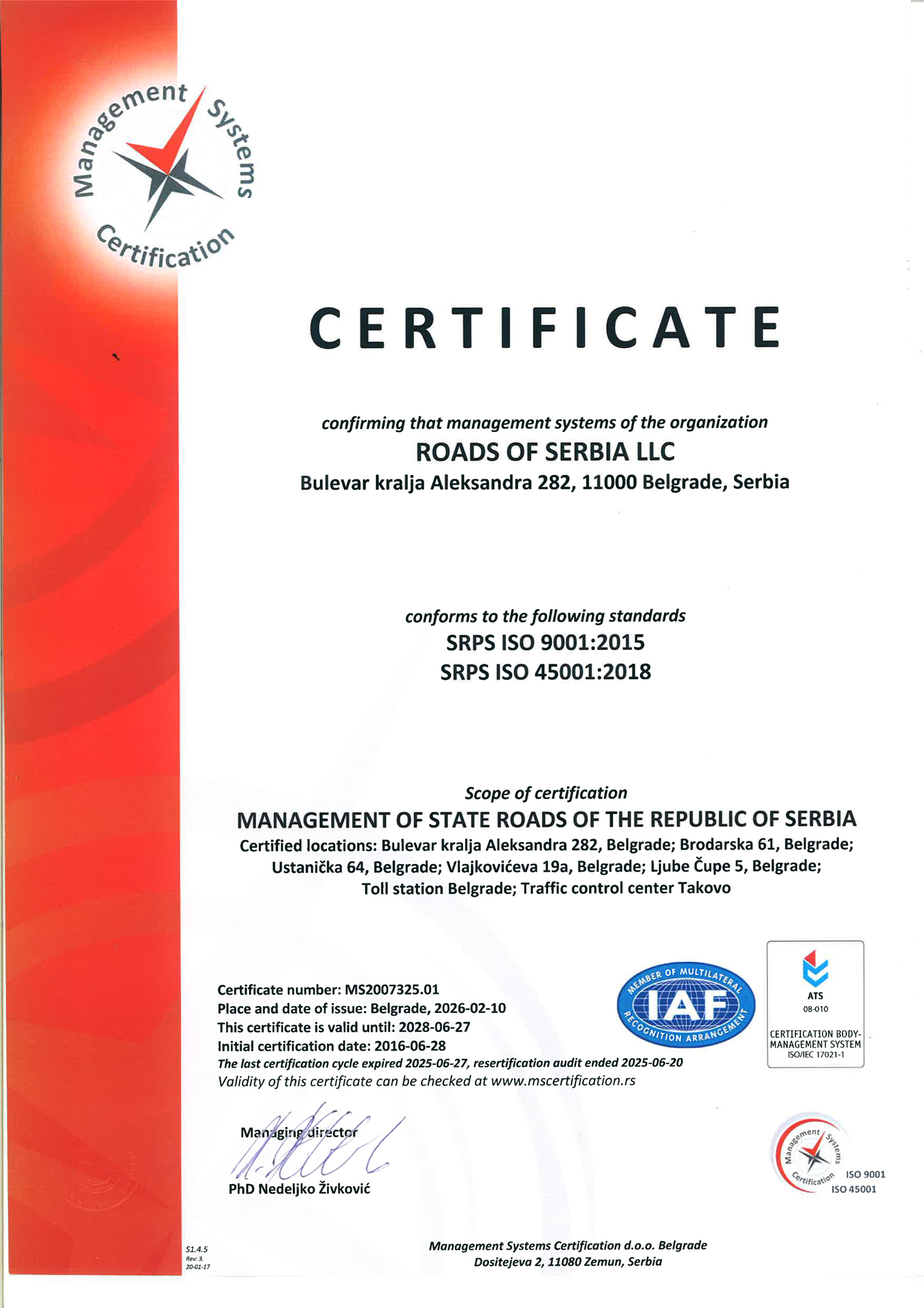
Road Traffic Safety Management System – SRPS ISO 39001
The Department for Road Traffic Safety actively participates in the development, implementation and continuous improvement of the Road Traffic Safety Management System in accordance with the SRPS ISO 39001 standard. The application of the principles of this international standard ensures a systematic approach to risk management, performance monitoring, objective setting and the planning of measures aimed at the continuous improvement of road safety on the state road network. In this way, road safety becomes an integral part of the Company’s management processes, decision-making and continuous business improvement.
The Company’s commitment to the implementation of the SRPS ISO 39001 standard demonstrates its dedication to the systemic management of road traffic safety and the continuous improvement of the safety performance of the road infrastructure.
Road Safety Indicators
The Department continuously monitors and analyses road safety indicators on the state road network of the Republic of Serbia. The analysis of traffic accident data, risk levels and the effectiveness of implemented measures provides the basis for planning new investments and setting priorities for improving the safety of the road infrastructure.
By monitoring trends and evaluating the results of implemented measures, decision-making based on evidence is provided, which is one of the fundamental principles of modern road infrastructure safety management.
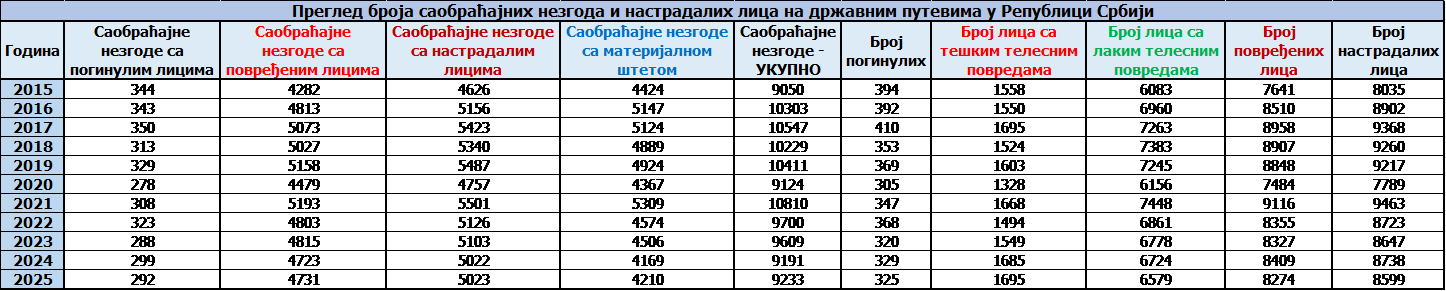
Table – Overview of the Number of Traffic Accidents and Casualties on the State Road Network, 2015-2025
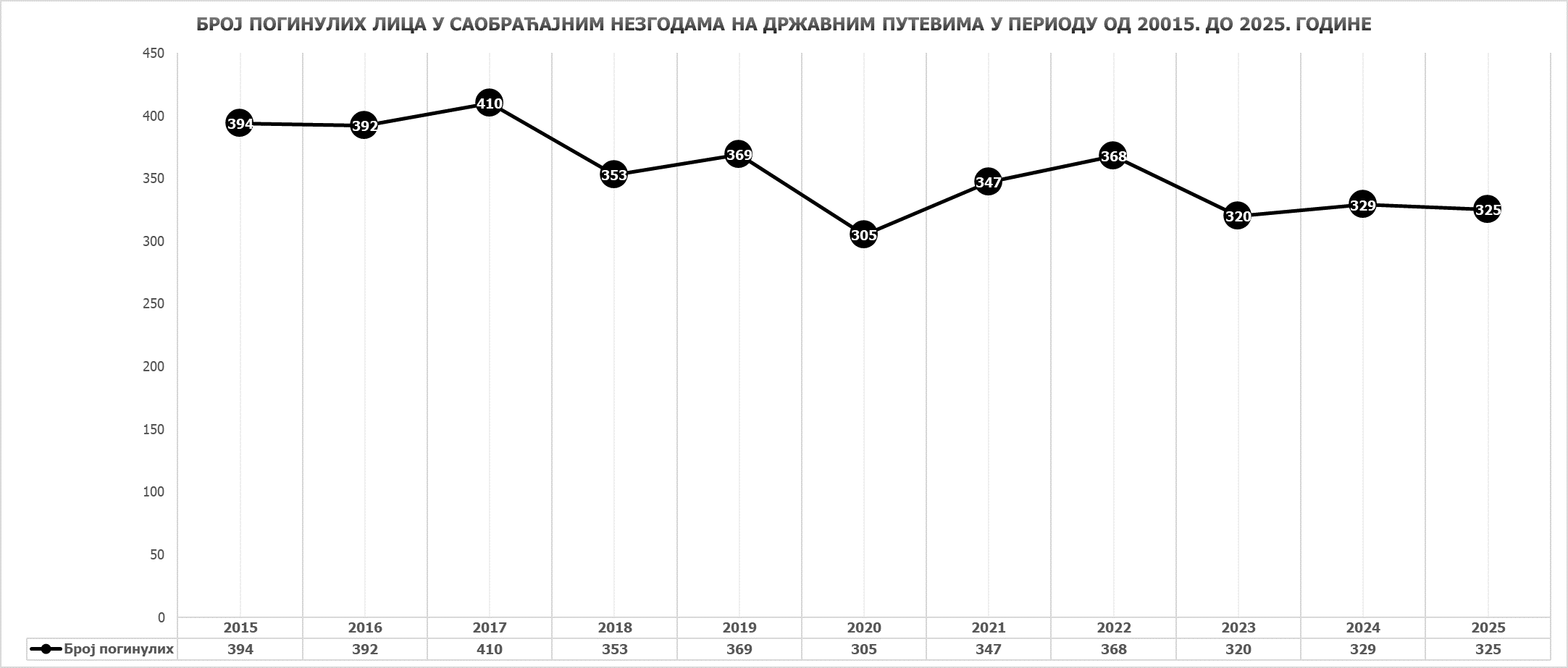
Graph – Number of Fatalities in Road Traffic Accidents on the State Road Network, 2015-2025