


| The National Centre for Traffic Monitoring and Management is primarily responsible for traffic monitoring and management, the preparation and implementation of ITS development plans for the state road network, road weather stations, video surveillance systems, variable message signs (VMS), telecommunications and power supply infrastructure, implementation of ITS on ongoing infrastructure projects, preparation of technical documentation, and the design and construction of regional traffic management centres. |
Traffic management systems are primarily intended to enhance road infrastructure through the integration of modern information and communication technologies (ICT). The main objectives of traffic management on the state road network of the Republic of Serbia include the optimal utilization of road network capacity by ensuring a stable traffic flow, reducing congestion, preventing potential traffic accidents, and providing road users with the best possible travel conditions.
With the aim of improving road safety on the state road network, as well as enhancing the efficiency, accessibility and sustainability of the transport network, one of the strategic priorities of “Putevi Srbije” is the development and implementation of Intelligent Transport Systems (ITS) on the state roads of the Republic of Serbia. In accordance with the “Concept for the Development of Intelligent Transport Systems on the State Road Network of the Republic of Serbia”, adopted by “Putevi Srbije” in 2020, as well as the adopted Business Programme and Public Procurement Plan, the Department for ITS Development and Implementation performs the following tasks:
- traffic monitoring and management on the I and II category state road network
- collection of traffic and technical data relating to roads and road users
- establishment and operation of the National and Regional Traffic Management Centres
- providing technical support to the Employer during the construction of tunnel facilities up to the issuance of the occupancy permit
- providing a wide range of services to road users through the operation of the Information Centre and a dedicated ITS GIS portal.
- conducting road safety assessments in tunnels and implementing measures to improve tunnel safety
- preparation of ITS equipment development plans and monitoring their implementation,
- providing support to the competent winter maintenance services on the state road network equipped with road weather stations (RWIS),
- development and implementation of road weather stations, monitoring their operation and maintenance during the warranty period;
- development and implementation of video surveillance systems, monitoring their operation and maintenance during the warranty period
- development and implementation of specialized video surveillance systems (ALPR-ADR), monitoring their operation and maintenance during the warranty period;
- development and implementation of Variable Message Sign (VMS) systems, monitoring their operation and maintenance during the warranty period;
- development and construction of telecommunications infrastructure on the state road network and monitoring its functionality during the warranty period
- development and construction of power supply infrastructure required for the implementation of ITS on the state road network
- implementation of ITS on ongoing infrastructure projects,
- preparation of Terms of Reference and issuance of guidelines for the development of design and technical solutions;
- design and construction of Regional Traffic Management Centres,
- participation in international projects aimed at improving traffic safety,
- implementation of the approved Public Procurement Plan, Business Programme and active contracts
Representatives of the National Centre are also appointed as representatives of “Putevi Srbije”under commercial contracts for the design and construction of state roads. They also provide technical support to the Employer during the construction of state roads and tunnel structures on the I and II category state road network.
Work of the National Centre for Traffic Monitoring and Management
The National Centre for Traffic Monitoring and Management comprises operational traffic management centres staffed on a 24/7 basis. Traffic monitoring and management are carried out through the ITS equipment and its elements.
Тunnels
Tunnels are among the most complex elements of the road network and are considered high-risk road structures from the road safety perspective, owing both to their specific structural characteristics and to the complexity of traffic operations within them. Consequently, tunnels, as specialized road structures, are subject to significantly more stringent road safety requirements. Traffic safety management aims to ensure uninterrupted and safe vehicle movement from tunnel entrance to exit while accommodating the reduced lateral clearance.
Tunnels and their influence zones are equipped with the following systems:
- Central Monitoring and Traffic Management System
- Video Surveillance System (general-purpose and dedicated)
- Tunnel Traffic Signage System
- Fire Detection and Alarm System
- Smoke and Heat Extraction System (Tunnel Ventilation System)
- Tunnel Lighting System
- Tunnel Public Address System
- Traffic Detection System (Automatic Traffic Counters)
- Emergency Call (SOS) and Tunnel Intercom System
- Tunnel Electrical Power System
- Tunnel Fire Hydrant System
- Hazardous Materials Drainage and Containment System
- Road Weather Information System
The following Intelligent Transport Systems (ITS) are operational on open road sections within the National Centre for Traffic Monitoring and Management:
- traffic signage system
- video surveillance system (general-purpose and special-purpose)
- road weather information system
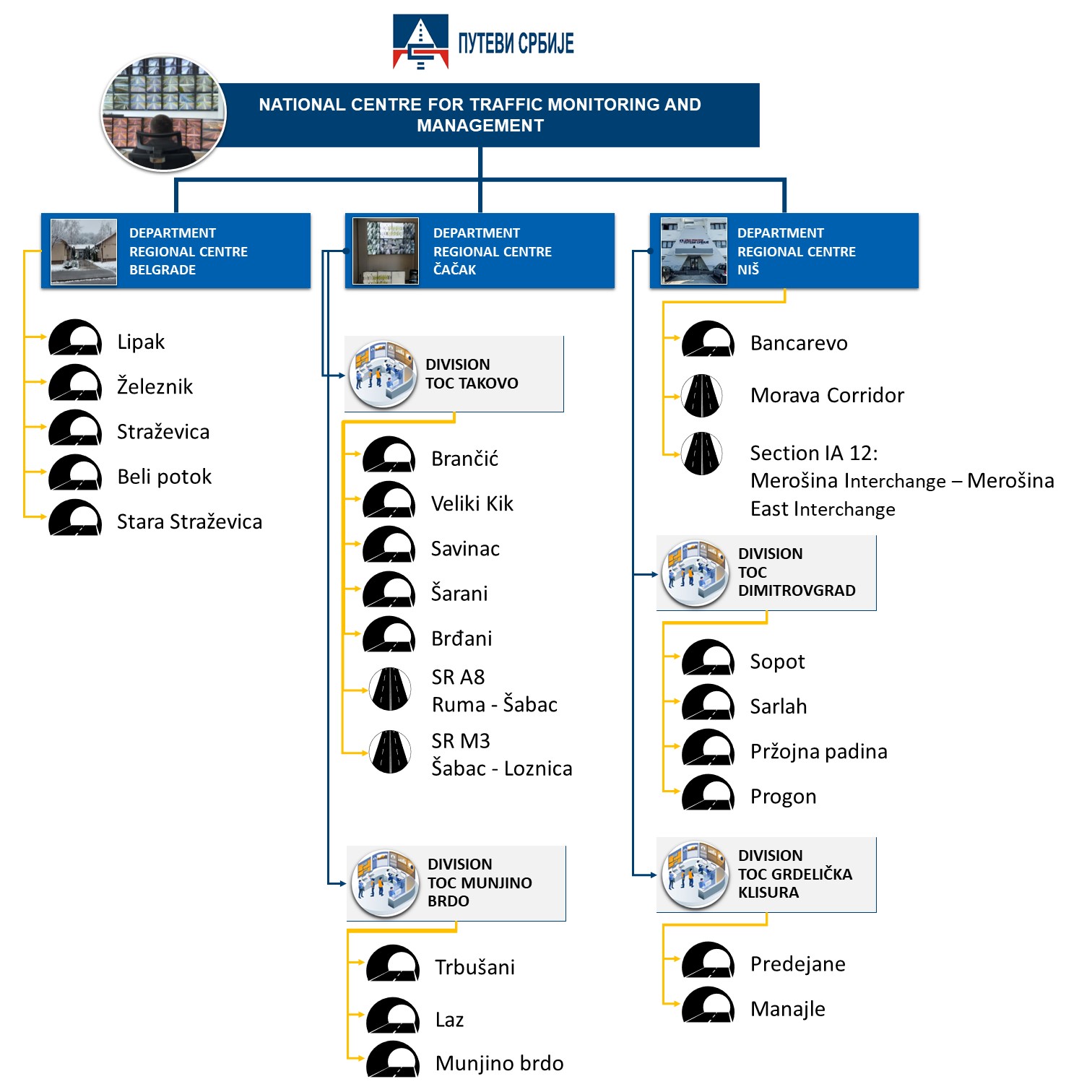
The National Centre is organised through regional centres, traffic operations centres and tunnel control centres, with 24/7 duty services. Its activities include continuous monitoring and detection of all incidents and alarms affecting the safety of road users, timely implementation of the prescribed activities in order to provide maximum support for the safe and stable flow of traffic on state roads, and detection of failures of the installed equipment.
The National Centre for Traffic Monitoring and Management comprises:
- Regional Centre Belgrade
- Regional Centre Čačak
- Regional Centre Niš and
- Regional Centre Novi Sad (currently being established).
Identification of Changes in ITS Equipment Status
All changes in the status of installed ITS equipment components may be identified through:
- the Central Traffic Monitoring and Management System (CTMS),
- the video surveillance system,
- regular inspections of the installed systems,
- reports by the competent authorities and services (police, fire brigade, road maintenance service).
Event Identification
Various systems installed in traffic operations centres can be used to detect different events occurring within a facility or its area of influence, such as:
- traffic accidents,
- formation of vehicle queues,
- stopped vehicles,
- wrong-way driving,
- presence of pedestrians or cyclists,
- roadworks,
- slow-moving vehicles,
- adverse weather conditions,
- power supply failure,
- foreign objects on the carriageway,
- and many others.
The current organisational structure of the National Centre by regional centres, traffic operations centres and tunnel control centres (RC/TOC/TCC) is presented below